
JÁ NÃO HÁ NADA by Léo Ferré
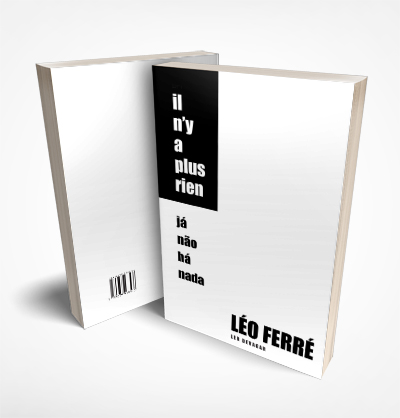
Why, then, translate and publish only this poem? For years the lyrics of this song, printed on the 1973 LP of the same title, had been almost fully translated. The translation had been interrupted by the setbacks of several lives. About a year ago, unexpected circumstances brought this translation back to life and finally completed it, and here it is, finished by chance in the year Léo Ferré would have turned 100, had he lived.
With the 2013 publication in France of the author's (almost) complete works, we chose the form in which it appears there, respecting the new punctuation and stanza arrangement.
It is a manifesto that is at once lyrical, biting and exhortative. Ferré's words, written in an old preface from 1956, hold true for this text too: «I wanted these few lines to be a manifesto of despair; I wanted these few lines to be, for the free men who remain my brothers, a manifesto of hope.»
The listener/reader, caught in its net, is left disconcerted, thunderstruck, exalted. We make our own the words of Mathieu Ferré, his eldest son: «…in the way he sings, his words and his music call out to you; you feel that he is speaking to you, to you, and to you alone.»
His satirical humour undoes language, religion, marriage, town planning, power and the exploitation of labour; but also the revolts and revolutions that have been co-opted and digested. This poem mattered to many of those who heard it: it makes you think. It is almost a summary of Ferré's thinking at a given historical moment. It is the first Portuguese translation. After his concert at the Coliseu dos Recreios in Lisbon in 1982, several of the author's texts (prose and poetry) were translated and published by the Ulmeiro publishing house, in 1984.
This major poem is not among them. His writing is of a fierce, moving beauty, with lines that are polished, unexpected, elided, filled with neologisms, popular expressions and slang. He is a great poet and singer waiting to be discovered.
The translators
About the Author
Léo Ferré was born in Monaco in 1916 and died in northern Italy in 1993. He was above all a troubadour, singer, poet and musician, though he also wrote a novel and many other prose texts. He set to music and sang the French poets: Villon, Baudelaire, Rimbaud, Verlaine, Apollinaire, Aragon… He left behind an impressive body of written and recorded work.